
Self-hosted task management open source software is code you install on your own server, licensed so you can read, modify, and audit it — but "open source" and "self-hosted" are separate decisions, not one checkbox. You can self-host proprietary software, and you can run open source code on someone else's cloud. What actually matters is who controls the server and who controls the code, because those two choices carry very different maintenance and risk trade-offs.
TL;DR:
- Self-hosted and open source are independent decisions — you can mix and match them, and most people don't realize it.
- Open source licenses (MIT, GPL, Apache) give you code access and modification rights, not free hosting, support, or maintenance.
- Real open source task tools worth trying include Taskwarrior, Vikunja, OpenProject, Focalboard, and Leantime — each with sharply different trade-offs.
- The real cost of self-hosting open source software is staff hours spent patching, backing up, and upgrading, not a license fee.
- If you want self-hosting without becoming your own IT department, paid one-time-purchase software splits the difference.
Table of Contents
- Self-Hosted Task Management, Open Source or Not: The Distinction That Matters
- What "Open Source" Actually Licenses You to Do
- The Bill You Don't See: Hosting, Patching, and Backups
- Where Open Source Task Tools Break for Trades Crews and Small Offices
- Self-Hosted Without Volunteering as IT: The Paid, One-Time Alternative
- Get Unlimited Seats on Your Own Server for One Flat Price
- Frequently Asked Questions
- Sources
Self-Hosted Task Management, Open Source or Not: The Distinction That Matters

Most people searching for self-hosted task management assume "self-hosted" and "open source" describe the same thing. They don't. Self-hosted means the software runs on a server you control — your office closet, a rented VPS, a rack in a data center. Open source means the code is published under a license, like MIT or GPL, that lets you read it, change it, and redistribute it. A piece of software can be one, both, or neither. Proprietary software can be self-hosted. Open source software can run entirely on someone else's cloud, with you never touching a server. Conflating the two is how people end up installing something that technically meets their "open source" checkbox but still requires a monthly subscription to a vendor's hosted version, or self-host something closed-source and assume they've lost all control of their data when they actually haven't. For a deeper breakdown of where this confusion shows up in project management specifically, see our look at open source task management self-hosted.
What "Open Source" Actually Licenses You to Do

An open source license is a legal document, not a feature list. The Open Source Initiative maintains the definition most projects point to, and it covers things like free redistribution, access to source code, and the right to modify and distribute derivative works. It says nothing about who hosts the software, who pays for the server, or who answers the phone when something breaks at 11 p.m. on a Friday. That's the gap a lot of small business owners fall into: they pick an open source task tool expecting it to be "free" in the budget sense, and it is free in the licensing sense, but the hosting, security, and upkeep costs don't disappear — they just move from a vendor's invoice to your own calendar.
Open source is a license, not a hosting choice. You can self-host proprietary software, and you can run open source code entirely inside someone else's cloud.
The Bill You Don't See: Hosting, Patching, and Backups

Running your own server means you inherit the jobs a SaaS vendor used to do invisibly: applying security patches, rotating backups, renewing certificates, and watching for the vulnerability that turns your task tracker into someone else's foothold. CISA's Open Source Software Security Roadmap calls out exactly this risk — open source components are now embedded in nearly everything, and the organizations running them are frequently the weakest link in keeping them patched, not the code itself. None of that is a reason to avoid self-hosting. It's a reason to be honest about what "free" software actually costs in staff time.
Pro Tip: Before you commit to any self-hosted tool, open a terminal and check how often the project ships security patches, not feature updates. A tool with quiet GitHub activity and no CVE history for two years isn't necessarily safe — it might just be unmaintained, which is worse.
Five Open Source Task Tools Worth Actually Running
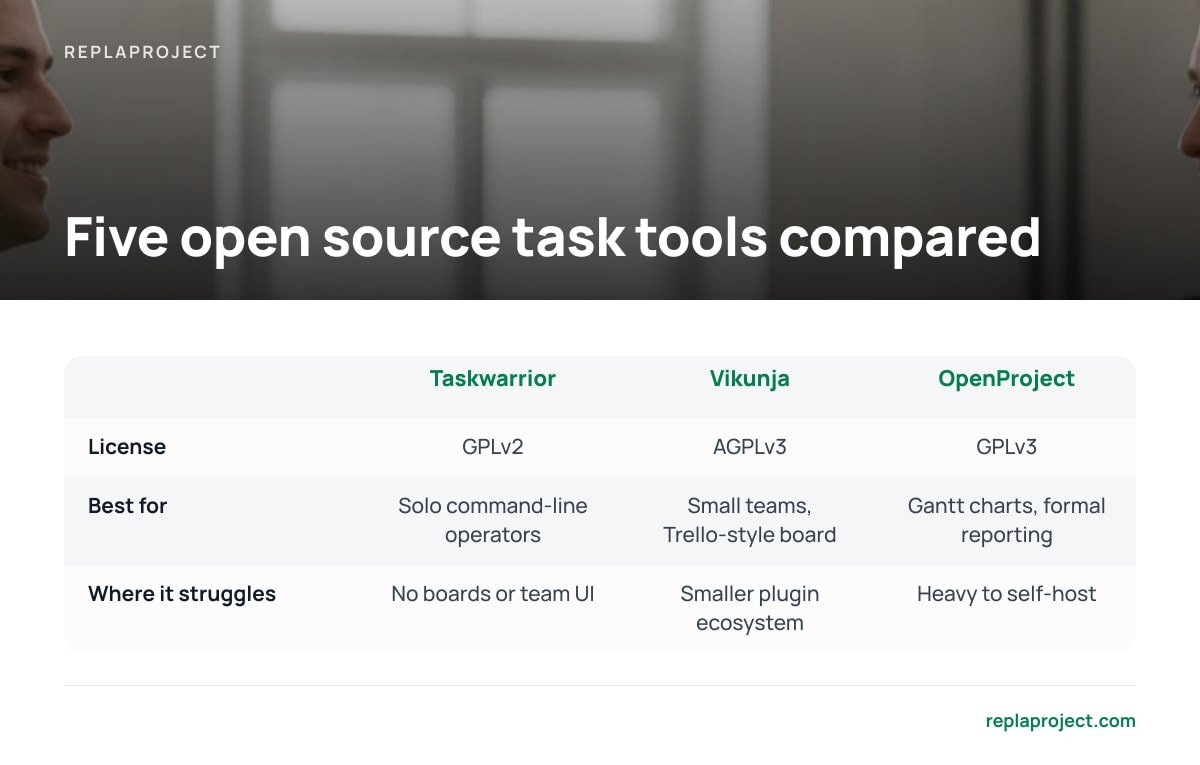
| Tool | License | Best for | Where it struggles |
|---|---|---|---|
| Taskwarrior | GPLv2 | Solo operators comfortable with a command line | No native boards, no team collaboration UI |
| Vikunja | AGPLv3 | Small teams wanting a Trello-style board | Smaller plugin ecosystem than larger platforms |
| OpenProject | GPLv3 | Teams needing Gantt charts and formal reporting | Heavy to self-host; steep learning curve for non-PMs |
| Focalboard | MPL 2.0 | Teams already using Mattermost | Development pace has slowed; fewer integrations |
| Leantime | AGPLv3 | Small teams wanting goal-tied project views | Less suited to dispatch-style, job-based work |
Each of these is genuinely open source, meaning you can clone the repository and read every line. None of them is purpose-built for a trades crew juggling job sites, subcontractors, and a flooded inbox of customer requests — because that isn't the problem most of their maintainers were solving.
Where Open Source Task Tools Break for Trades Crews and Small Offices
The gap shows up in three places consistently. First, intake: most open source task tools assume someone manually creates every task, with no built-in way to turn an incoming customer email into a tracked job. Second, dependencies: knowing that Job B can't start until Job A's materials arrive is either a manual note field or missing entirely. Third, field use: a command-line tool or a dense Gantt interface doesn't survive contact with a crew member standing in a driveway with a phone.
Taskwarrior has been actively maintained since the mid-2000s — longer than most of the SaaS platforms it competes against have even existed.
None of this makes the tools bad. It means they were built by and for people solving a different problem than "track forty jobs across three crews and a subcontractor who never answers texts." If you're weighing a fully open source stack against the licensing math of something like Jira's self-hosted tier, our breakdown of Jira self-hosted pricing is worth reading side by side with this one — the per-user costs on "enterprise" self-hosted options tend to surprise people more than the open source ones do.
Self-Hosted Without Volunteering as IT: The Paid, One-Time Alternative
There's a third category that doesn't get talked about enough: software that is self-hosted but not open source, sold once for a flat fee instead of licensed per seat per month. You don't get to read the source code, but you also don't inherit the obligations that come with running unmaintained open source projects indefinitely, and you're not stuck re-arguing your software budget with finance every January. We've written at length about the real math behind this choice in our comparison of open source and self-hosted project management and in what you're really choosing with project management open source self-hosted tools — both worth a read if you're trying to decide which trade-off fits your team.
If you've looked at the open source route and found it a little thin on built-in automation, it's also worth seeing what a "free" self-hosted platform actually costs once you tally the hours, in our Orangescrum self-hosted breakdown.
Get Unlimited Seats on Your Own Server for One Flat Price
If what you actually want from "self-hosted task management" is control over your data without turning into a part-time sysadmin, ReplaProject is built around that exact trade-off. It's self-hosted, sold once for $399 flat instead of per-seat-per-month, and it adds unlimited people at no extra cost — add the whole crew, the subcontractors, the office, and don't pay more for any of it. It handles job tracking across board, table, and calendar views, turns a forwarded email into a task automatically, gives customers a public intake form instead of a group text, and flags what's blocking a job before you find out the hard way.
The honest caveat: it isn't open source, so if your requirement is reading and modifying the underlying code, this isn't your tool — one of the projects above is. Check the spec sheet against your actual needs before you buy either way.
Frequently Asked Questions
Is self-hosted task management the same thing as open source task management?
No. Self-hosted describes where the software runs — on a server you control. Open source describes the license the code is published under. A tool can be self-hosted and proprietary, open source and cloud-hosted, or both self-hosted and open source at once.
What license should I look for in open source task management software?
Common choices are MIT, Apache 2.0, and GPL variants like GPLv3 or AGPLv3. MIT and Apache are permissive and let you modify and redistribute with few obligations; GPL and AGPL require that modifications you distribute stay open source, which matters if you plan to resell or heavily customize the tool.
What are the best open source alternatives to Trello or Asana?
Vikunja and Focalboard come closest to a Trello-style board experience. OpenProject and Leantime lean more toward formal project management with Gantt charts and goal tracking. Taskwarrior is a command-line option for individuals rather than teams.
How much does it cost to self-host open source project management software?
There's no license fee, but you'll pay for server hosting, and the real cost is staff time spent on patching, backups, and upgrades. Budget a few hours a month minimum, more if the project ships frequent security updates or you're running it for a larger team.
Can I self-host software that isn't open source?
Yes. Self-hosting is about where the software runs, not what license it carries. A number of vendors sell self-hosted software under a one-time or subscription license without publishing the source code, which trades code access for less ongoing maintenance burden.
Does switching to self-hosted mean I lose automatic updates?
Usually, yes — updates become something you pull and apply yourself rather than something that happens silently overnight. Some self-hosted vendors ship update packages you install manually; fully open source projects typically expect you to track their release channel yourself.
Sources
- The Open Source Definition | Open Source Initiative
- Taskwarrior | Taskwarrior Project
- Vikunja | Vikunja
- OpenProject | OpenProject GmbH